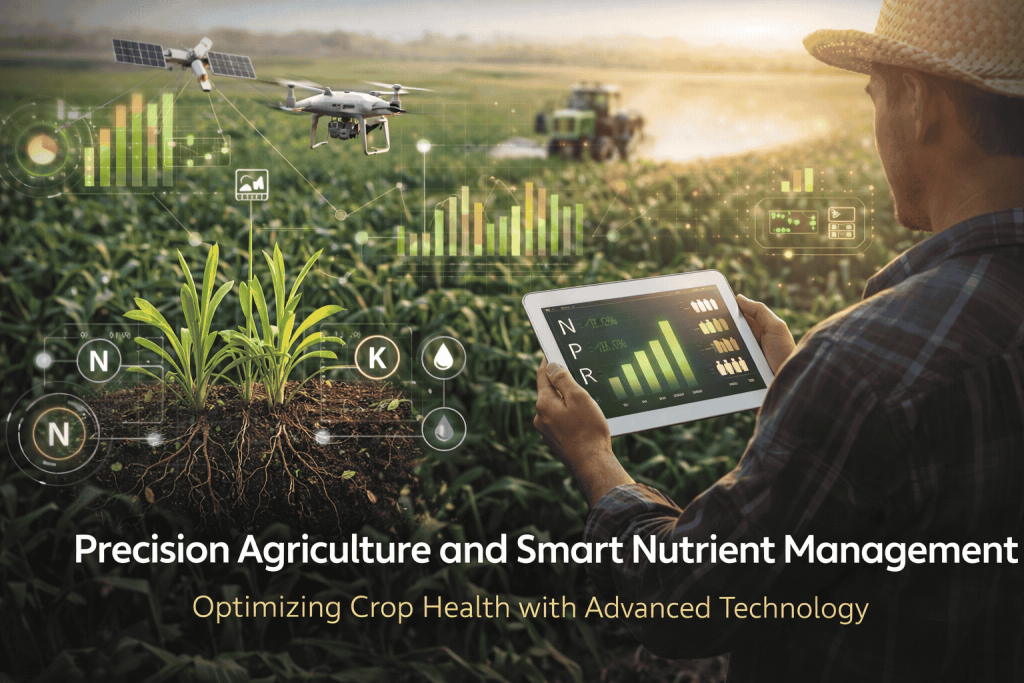
Transforming Modern Farming
Agriculture is becoming more technology-driven as farmers and agricultural professionals seek efficient ways to improve crop productivity while managing resources responsibly. One of the most significant developments in recent years is the adoption of precision agriculture, which focuses on optimizing farm inputs such as water, fertilizers, and crop protection products.
Precision agriculture allows farmers to manage their fields more accurately by using data, modern irrigation systems, and advanced crop nutrition practices. A key component of this approach is smart nutrient management, where fertilizers are applied in a way that ensures plants receive the right nutrients at the right time.
By combining modern farming technologies with advanced fertilizer solutions, precision agriculture is helping improve crop yield, nutrient efficiency, and overall farm productivity.
What is Precision Agriculture?
Precision agriculture is a farming approach that uses technology and data to improve decision-making in crop production. Instead of applying fertilizers and other inputs uniformly across the entire field, farmers can adjust their practices based on soil conditions, crop needs, and environmental factors.
This approach helps optimize the use of agricultural inputs, making farming more efficient and sustainable.
Precision agriculture practices often include:
Soil testing and nutrient analysis
Precision fertilizer application
Fertigation systems
Drip irrigation technology
Data-driven crop management
These tools allow farmers to better understand the nutritional needs of their crops and apply fertilizers more effectively.
Importance of Smart Nutrient Management
Nutrient management plays a vital role in crop productivity. Crops require a balanced supply of essential nutrients to grow properly and produce high yields.
Smart nutrient management focuses on providing crops with the correct combination of macronutrients and micronutrients while minimizing nutrient losses.
Key principles of effective nutrient management include:
Applying the right type of fertilizer
Delivering nutrients at the right time during crop growth
Ensuring nutrients are applied in the right quantity
Improving nutrient availability and absorption
By following these principles, farmers can improve nutrient efficiency while maintaining soil fertility.
Role of Specialty Fertilizers in Precision Agriculture
Specialty fertilizers play an important role in precision agriculture because they are designed to provide efficient and targeted nutrient delivery.
Unlike conventional fertilizers, specialty fertilizers are formulated to improve nutrient stability and plant availability. This allows crops to absorb nutrients more efficiently, leading to better growth and productivity.
Common specialty fertilizer solutions used in precision agriculture include:
Specialty NPK fertilizers
NPK Liquid fertilizers
Water soluble fertilizers
Chelated micronutrient fertilizers
Biostimulants
These products support modern nutrient management systems and help farmers achieve more consistent crop results.
Fertigation and Efficient Nutrient Delivery
Fertigation is a widely used technique in precision agriculture where fertilizers are applied through irrigation systems. This method allows nutrients to be delivered directly to the plant root zone, ensuring efficient absorption.
Fertigation offers several advantages:
Uniform nutrient distribution
Reduced fertilizer wastage
Better control over nutrient application
Improved nutrient availability for crops
Liquid fertilizers and water soluble fertilizers are commonly used in fertigation systems due to their high solubility and ease of application.
Importance of Micronutrients in Precision Farming
While macronutrients such as nitrogen, phosphorus, and potassium are essential for plant growth, micronutrients also play a critical role in crop development.
Nutrients such as zinc, iron, manganese, and boron are involved in important plant functions including enzyme activity, photosynthesis, and root development.
In precision agriculture, micronutrient fertilizers are often applied based on soil testing and crop requirements, ensuring that plants receive the nutrients they need for optimal growth.
Chelated micronutrients are particularly useful because they help maintain nutrient stability and improve plant absorption.
Benefits of Precision Nutrient Management
Adopting precision agriculture and smart nutrient management practices offers several advantages for modern farming systems.
Improved Nutrient Use Efficiency
Precise fertilizer application helps crops utilize nutrients more effectively, reducing nutrient losses.
Higher Crop Productivity
Balanced crop nutrition supports stronger plant growth and improved crop yield potential.
Reduced Environmental Impact
Efficient nutrient management helps reduce nutrient runoff and improves sustainability in agriculture.
Better Resource Management
Precision farming practices allow farmers to use fertilizers, water, and other inputs more efficiently.
Conclusion
Precision agriculture is transforming modern farming by helping farmers manage their crops more efficiently and sustainably. By combining technology with advanced fertilizer solutions, farmers can deliver nutrients more accurately and improve overall crop performance.
Smart nutrient management, supported by specialty fertilizers, micronutrients, and efficient fertilizer application systems, plays an important role in achieving productive and sustainable agriculture.
As global agriculture continues to adopt modern technologies, precision nutrient management will remain a key strategy for improving crop productivity and maintaining long-term soil health.